


Grease Management and Health Department Compliance: What Restaurants Need to Know
Quick answer: Grease management is the system restaurants use to control fats, oils, and grease across used cooking oil storage, grease traps or interceptors, drains, cleaning routines, and service schedules. It matters for compliance because health inspectors care about sanitation and facility condition, while local wastewater or pretreatment authorities often care about how FOG affects sewer systems. For restaurants, that means grease management is not just about pumping a trap when something goes wrong. It is about keeping grease out of the wrong places, keeping service areas clean and accessible, following a realistic maintenance schedule, and having enough documentation to show the system is being managed on purpose. Baker’s Total Grease Management aligns with that broader view by bundling services such as grease collection, drain cleaning, and preventive maintenance into one coordinated program.
At a glance
• Grease management usually involves more than one grease stream, including used cooking oil and grease trap waste.
• Health department compliance and wastewater compliance often overlap, but they are not the same thing.
• Poor grease management can contribute to sanitation issues, drain problems, and documentation gaps.
• Baker positions integrated grease management as a way to simplify service, reduce errors, and support compliance.
What grease management really means in a restaurant
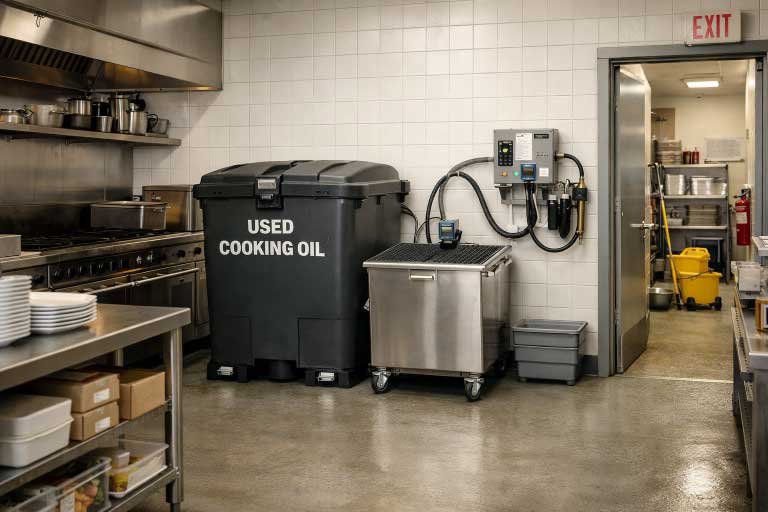
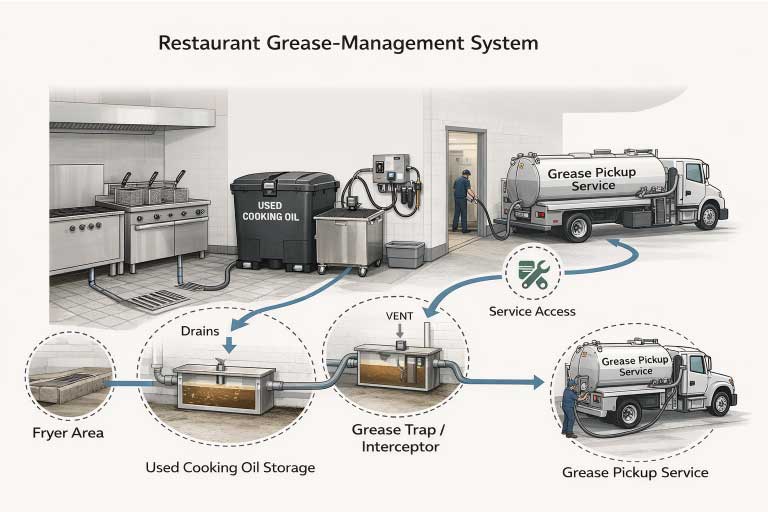
A lot of restaurant teams use “grease management” as shorthand for one service, usually grease trap pumping. That definition is too narrow to be useful. Baker’s integrated grease-management content describes a wider system that can include used cooking oil collection, grease trap service, interceptor pumping, line jetting and drain cleaning, preventive equipment maintenance, and customized storage solutions.
EPA’s FOG guidance supports the same broader framing. It explains that food service establishments generate fats, oils, and grease as byproducts of food preparation and that on-site FOG handling usually includes more than one stream, including yellow grease and grease trap waste. In practice, that means restaurants are usually managing more than one grease problem at the same time, even if staff think of it as one issue.
This matters because real kitchens do not experience sanitation, drainage, storage, and maintenance as separate categories. A dirty service area, a neglected trap, a blocked line, or poorly handled used cooking oil can all contribute to the same operational outcome: a restaurant that is harder to keep clean, harder to inspect confidently, and more likely to face avoidable issues.
How health department compliance connects to grease management
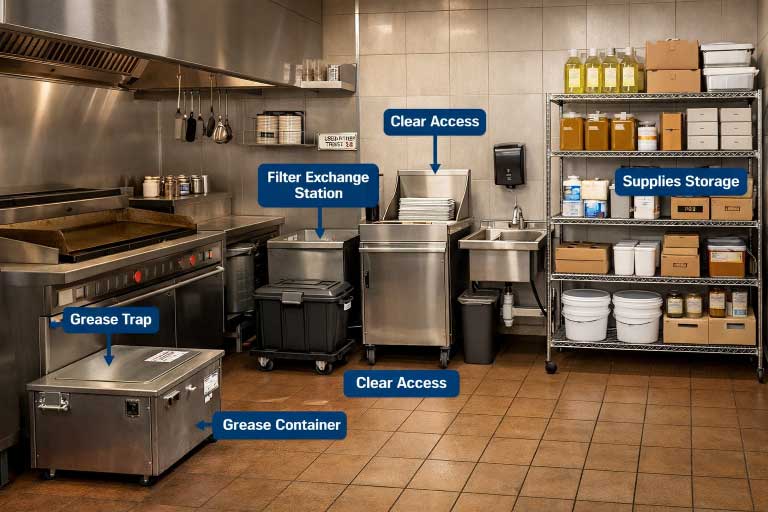
The phrase “health department compliance” can make this topic sound narrower than it is. In restaurant operations, grease management affects compliance because it shapes sanitation, facility condition, waste handling, and the cleanliness of the back-of-house environment. The Food Code says physical facilities must be maintained in good repair and cleaned as often as necessary to keep them clean, and it also says that if a grease trap is used, it must be easily accessible for cleaning.
That does not mean the FDA directly enforces every restaurant grease rule in every city. The Food Code is a model offered for adoption by jurisdictions, and local state or municipal rules can vary. Still, it gives a strong baseline for what regulators are trying to accomplish: sanitary operations, maintained facilities, and proper waste handling.
Baker’s own content makes the practical link clear. Its articles on integrated grease management and grease trap neglect argue that staying on the right service schedule, keeping systems maintained, and having compliance paperwork can help reduce the risk of citations, fines, or operational headaches from local regulators.
Who regulates what: health departments, municipalities, and sewer authorities
One reason restaurant teams get confused is that more than one authority may be involved. Health departments usually focus on sanitation, facility condition, and conditions that support safe food handling. Local sewer agencies, wastewater utilities, or pretreatment programs often focus more on what enters the sewer system, how FOG is controlled, and whether the restaurant is contributing to blockages or overflows.
That distinction matters because a restaurant can think it has “just” a trap issue while the local utility sees a wastewater problem, or think it has “just” a cleanliness issue while an inspector sees weak maintenance and sanitation controls. The most credible way to explain this is simply to say that grease compliance is usually shared across overlapping systems, not owned by one rulebook alone.
That is also why this article should avoid pretending there is one universal national checklist. The FDA Food Code is a model code, while local jurisdictions may adopt it differently and layer on additional FOG-control rules, permits, or inspection processes.
Common compliance risks caused by poor grease management
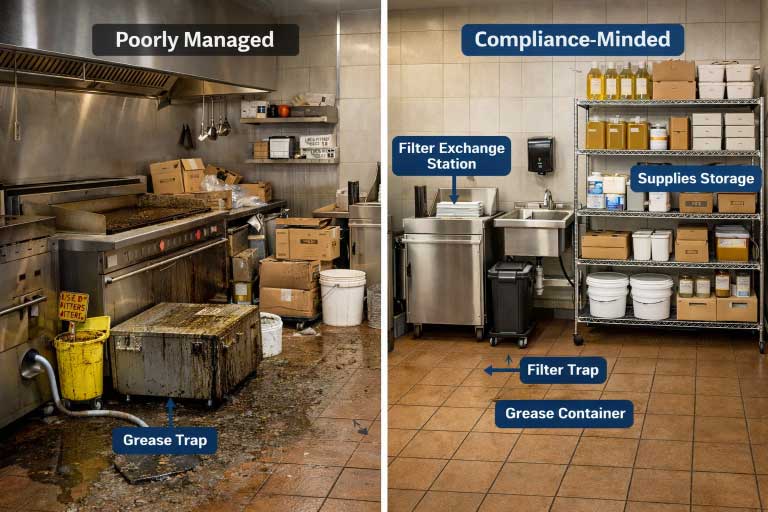
The first compliance risk is physical mess turning into a sanitation problem. If grease storage areas are dirty, if residue builds up, or if service points are not maintained well, the issue stops being hidden infrastructure and starts becoming part of the restaurant’s visible operating condition.
The second risk is trap or interceptor neglect. Baker’s grease-trap service pages and educational articles say regular pumping is important for preventing fats, oils, grease, and solids from clogging sewer lines, and working with an experienced pumping company helps restaurants stay on the right schedule and reduce the chance of citations or fines from local regulators.
A third risk is letting FOG move into the wrong place. EPA’s FOG guidance explains that controlling restaurant grease discharges matters because FOG contributes to sewer blockages and overflows. A fourth risk is poor documentation. Documentation does not replace actual maintenance, but it can help show that grease systems are being serviced consistently rather than only after something fails.
A practical grease management checklist for restaurants
Grease management checklist
- Know which grease streams you are managing – understand which material goes where and which service applies to each stream.
- Keep grease-handling areas clean and serviceable – storage areas, service access points, and nearby surfaces should be orderly so leaks, spills, or tampering become obvious.
- Make traps and related equipment accessible – if a grease trap is used, it should be easily accessible for cleaning.
- Align service frequency with real kitchen output – match service schedules to actual output and local rules instead of relying on fixed assumptions.
- Keep records that show routine maintenance – service tickets, pump records, pickup history, and simple internal check logs help show consistency.
- Treat drain issues as an early warning sign – backups, slow drains, odor, repeated clogs, or unusual residue should not be treated as normal.
- Review whether one provider can simplify the system – compliance is easier when responsibility is clearer and the system is managed as one coordinated process.
Common mistakes that create inspection or operational headaches
One common mistake is treating grease management as a single-vendor chore instead of a working system. Splitting used cooking oil pickup, trap pumping, drain service, and preventive maintenance across disconnected workflows can create more room for delays, missed service, and unclear accountability.
Another mistake is assuming that if the visible kitchen looks clean, the restaurant is covered. The standard is broader than that. Equipment access, routine cleaning, maintenance, and proper waste handling all matter.
A third mistake is relying on fixed schedules without checking whether they still match real output. A schedule that worked months ago may not fit a higher-volume season, a changed menu, or a different staffing pattern.
A fourth mistake is weak recordkeeping. Restaurants do not need a bureaucracy around grease, but they do need enough records to show maintenance is happening consistently.
A final mistake is treating slow drains, odor, or recurring minor grease problems as normal. Small warning signs are often cheaper to address than backups, spills, or inspection trouble later.
Why an integrated grease management partner can help
The reason an integrated partner matters is not just convenience. It is clarity. Baker’s Total Grease Management positioning is built around the idea that used cooking oil collection, grease trap and interceptor pumping, drain cleaning, and preventive maintenance work better when they are coordinated as one program.
That systems approach also fits the way regulators see the issue. Restaurants live in the overlap between sanitation expectations and wastewater-control expectations, so a provider that understands only one slice of the problem may still leave operators doing the coordination work themselves.
The most credible takeaway is simple: restaurants usually do better when someone is looking at the whole grease system, not just one task at a time. Integrated responsibility often makes inspections, maintenance, documentation, and problem prevention easier to manage.
Conclusion
Grease management is easy to underestimate because so much of it happens behind the scenes. But for restaurants, it affects more than plumbing. It touches sanitation, equipment access, facility condition, wastewater control, service documentation, and overall inspection readiness.
For restaurant operators, the next step does not need to be complicated. Start by asking whether your current setup makes grease handling easy to monitor, easy to service, and easy to document. If not, that is where a stronger grease-management system begins.
Need a more coordinated grease-management setup? If your restaurant is juggling used cooking oil, grease traps, drain issues, and service paperwork through disconnected routines, review whether your current system is truly helping you stay organized.
Frequently Asked Questions
Grease management is the overall system a restaurant uses to control fats, oils, and grease across used cooking oil storage, trap or interceptor service, drain protection, and routine maintenance.
It affects compliance because grease handling influences sanitation, facility condition, and whether physical systems stay clean and serviceable.
Requirements vary by jurisdiction and site type, so there is no single universal rule that applies everywhere. Local wastewater or pretreatment programs frequently regulate FOG control in food-service settings.
There is no one universal answer. Frequency depends on local requirements, system type, and actual grease output, so operators should follow site conditions and local rules instead of assuming one schedule fits all.
Yes. Poor grease management can contribute to unsanitary conditions, inaccessible equipment, drain issues, and weak maintenance records, all of which can create compliance problems or make inspections harder to navigate.
Useful records can include pump tickets, pickup history, service reports, and basic internal logs that show the system is being maintained consistently.
Used cooking oil collection deals with recyclable yellow grease or fryer oil, while grease trap service deals with trap or interceptor waste and related wastewater solids.
Often, yes. A centralized model can save time, reduce errors, and simplify compliance by coordinating collection, pumping, drain maintenance, and related support in one program.